
Galley planning
Without risking divorce, starvation or accidental overeating.
The first time you book a sailing holiday, the anxiety that hits you at the marina is usually not about manoeuvres or the weather.
It is about food.
Driven by a sudden survival instinct worthy of a zombie apocalypse documentary, you rush to the nearest supermarket by the harbour and buy enough supplies to feed an army for three months.
The result? Boats sailing permanently off balance because of thirty kilos of pasta, and saloons turned into bunkers full of canned beans.
Sailing “off-grid” for a week, forgetting about marinas and enjoying only the quietest bays, is one of the true luxuries that sailing gives you.
And you do not need the survival skills of a monk seal to do it: you just need to apply a little maths to your summer laziness.
Here is how to organise the perfect galley without turning your catamaran into a Civil Protection warehouse.
The first scientific mistake is overestimating your energy consumption.
During a classic week of summer relaxation, your average physical activity will probably consist of three refreshing swims, twenty minutes spent trying to stay balanced on a SUP, and the repeated lifting of a glass of wine at sunset, followed by the highly athletic act of throwing peanuts or taralli into your mouth.
You are not climbing Everest, and you are not competing in the Olympics.
Heat reduces appetite and increases the need for hydration. Nutrition science tells us that the ideal galley for this type of light activity should focus on simple, easy-to-store and well-balanced meals:
The ideal balance
Knowing the exact number of calories is useful for one thing only: avoiding dead weight on board without going hungry.
If we look at the real numbers to avoid getting the shopping wrong, the daily calorie requirement per passenger follows some simple mathematical rules:
Requires around 2,560-2,720 kcal per day, calculated using the rule of 32-34 kcal per kg of body weight.
Requires around 1,500-1,600 kcal per day, based on 30-32 kcal per kg of body weight.
Going for giant portions or heavy ready-made sauces that are hard to digest under a 35°C sun means only one thing: condemning the crew to a permanent food coma.
Before pushing the trolley down the supermarket aisles, let’s get rid of two great sailing illusions:
The professional fisherman myth
Buying very little food because “we’ll catch tuna every evening anyway” is the fastest way to go hungry. Summer trolling, among passing boats and engine noise, is a gamble. If you catch something, great: it will be a bonus. If you do not, you need to have plan B ready in the pantry.
The bunker effect
Cans are convenient, but they are very heavy and generate an embarrassing amount of solid waste. A stock of canned food for four people over seven days can easily weigh 12-15 kg and fill the space of two medium lockers. Remember that everything you bring on board stays on board until you find a bin ashore. Rubbish and heat do not get along. Keep cans to the bare minimum.
Modern cruising boats are equipped with efficient refrigerators. The fridge is your best friend, but space is not unlimited.
Fresh meat, fish, milk and fresh dairy products, cooked leftovers and opened preserves take priority. And you will probably want to leave some space for wine, and maybe even tonic water for the gin.
This is why fruit and vegetables need to be able to survive outside the fridge too, in lockers or in hanging nets.
Choose varieties that can handle the heat. For vegetables, go for tomatoes, carrots, courgettes, cucumbers, green beans, potatoes, lettuce and onions. For fruit, choose apples, pears, bananas, peaches, apricots, plums and melon.
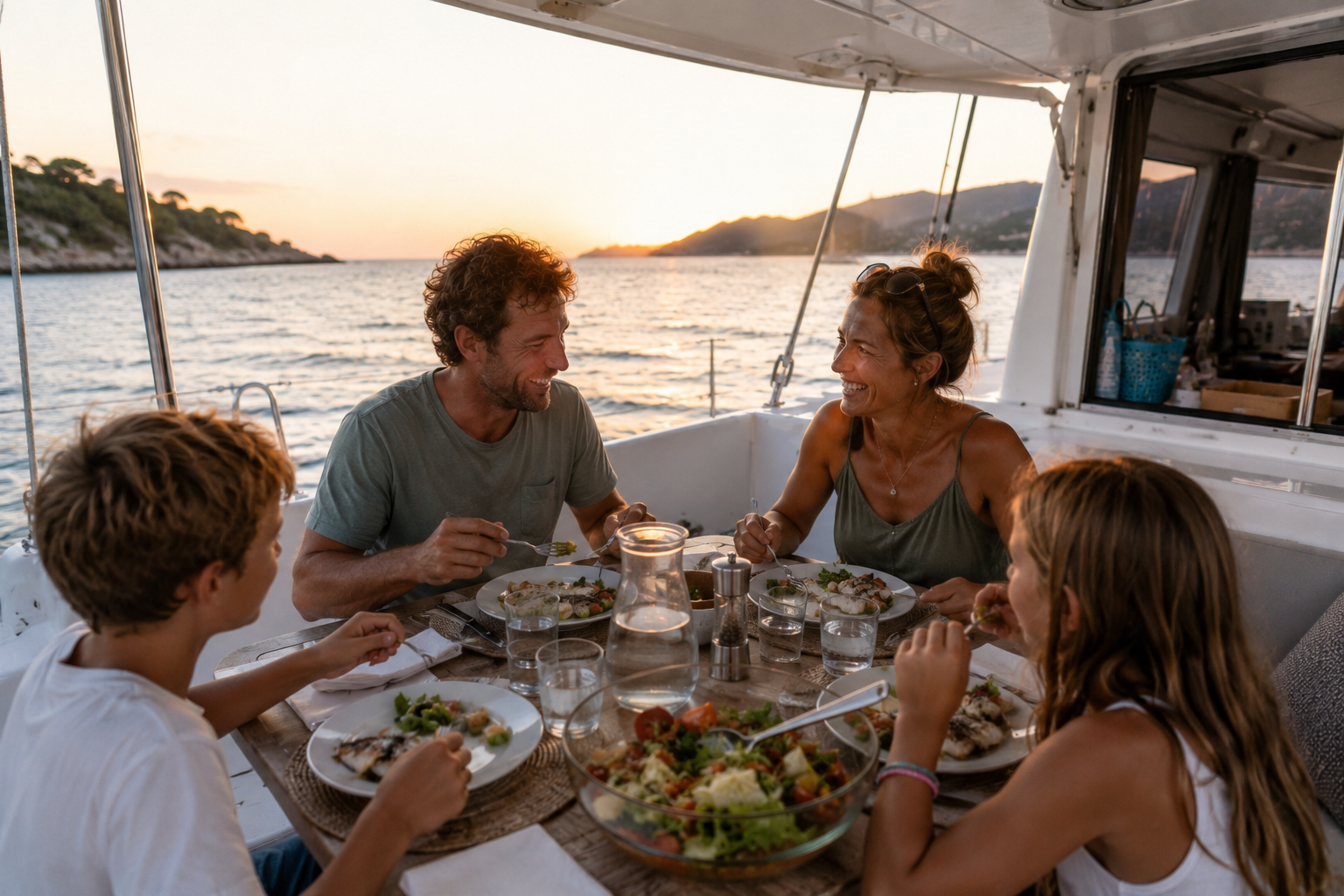 .
.
To give you an idea of what it means to turn theory into practice for a week of autonomous sailing, here are the real weights and portions to calculate per person for an 80 kg man, with the menu set at around 2,400-2,600 kcal per day. For a woman, consider roughly 40% less:
Blue gold
In summer, water is the absolute priority on board. As a practical reference, calculate at least 1.5 litres per person per day just for drinking, increasing this amount if it is very hot or if you are sailing for long periods. Keep it below deck, under the floorboards or in a locker, and it will stay cool enough to be pleasant.
A well-balanced and very easy day on board could look like this: breakfast with milk or yogurt and biscuits or crispbread; lunch with tuna pasta and fresh tomatoes; an afternoon snack with fresh fruit and nuts; dinner with cold rice or couscous, legumes, vegetables and a drizzle of olive oil. Minimum cooking, maximum energy.
A smart off-grid galley needs to be flexible. What happens if, on the evening of day four, you decide to go ashore by tender for a pizza or a seafood dinner at that little local restaurant you discovered by chance?
To avoid wasting food and overloading the fridge, simply apply the subtraction method. For every person who skips dinner on board, remove from the weekly supplies:
At sea, elegance lies in subtraction, even when you open the fridge.
In summary
Organising provisions for a week on board means choosing simple, balanced foods that are easy to store and genuinely useful for life at sea.
Less unnecessary weight, less waste, less stress. More quiet bays, more freedom and more time to enjoy the sea.
Article by Giacomo Giulietti of LLiquida - Marketing and Communication for the Nautical Industry.

€ 4,040
price of the whole boat

€ 2,240
price of the whole boat

€ 1,658
price of the whole boat

€ 4,760
price of the whole boat

€ 5,355
price of the whole boat

€ 2,975
price of the whole boat

€ 2,480
price of the whole boat

€ 2,635
price of the whole boat
Our regular email newsletters include information about our boats, holiday ideas, destination insights and cultural briefings. You can unsubscribe at any time and we'll treat your data with respect, never passing on your details to third parties. Find full details of our data management in our Privacy policy page
By signing up, I agree to Master Yachting's T&C's and Privacy policy

Looking for inspiration for your next sailing holiday? Packed with insights on trending sailing destinations plus stories from expert sailors and first-timers, our brand new digital magazine - Magister Navis - will guide your way to your next sail.
View magazine

