
You’ve taken over your charter boat and you’re almost ready to set off. But how do you get to know the boat well enough to enjoy a stress-free sailing holiday – and avoid turning your marina manoeuvres into an unintentional spectacle? Here are our tips for getting familiar with your boat quickly and easily.
You can carry out the first checks while you’re still in the marina, with the boat safely secured to the dock.
To make sure hoisting the sails goes smoothly the first time, it’s worth taking a good look at the sheet layout and reefing system. That way, there’ll be no unpleasant surprises later when conditions out on the water may already be getting a little uncomfortable.
How is the main halyard attached and secured?
Does someone need to go to the mast to hoist the mainsail, or can it be hoisted from the cockpit?
Does the boat have an in-mast furling system or a fully battened mainsail with lazy jacks?
How is the mainsheet led?
How does the reefing system work?
Taking the time to check all of this calmly while you’re still in the marina will save you both time and stress once you’re out on the water. The same applies to the headsail furling system.
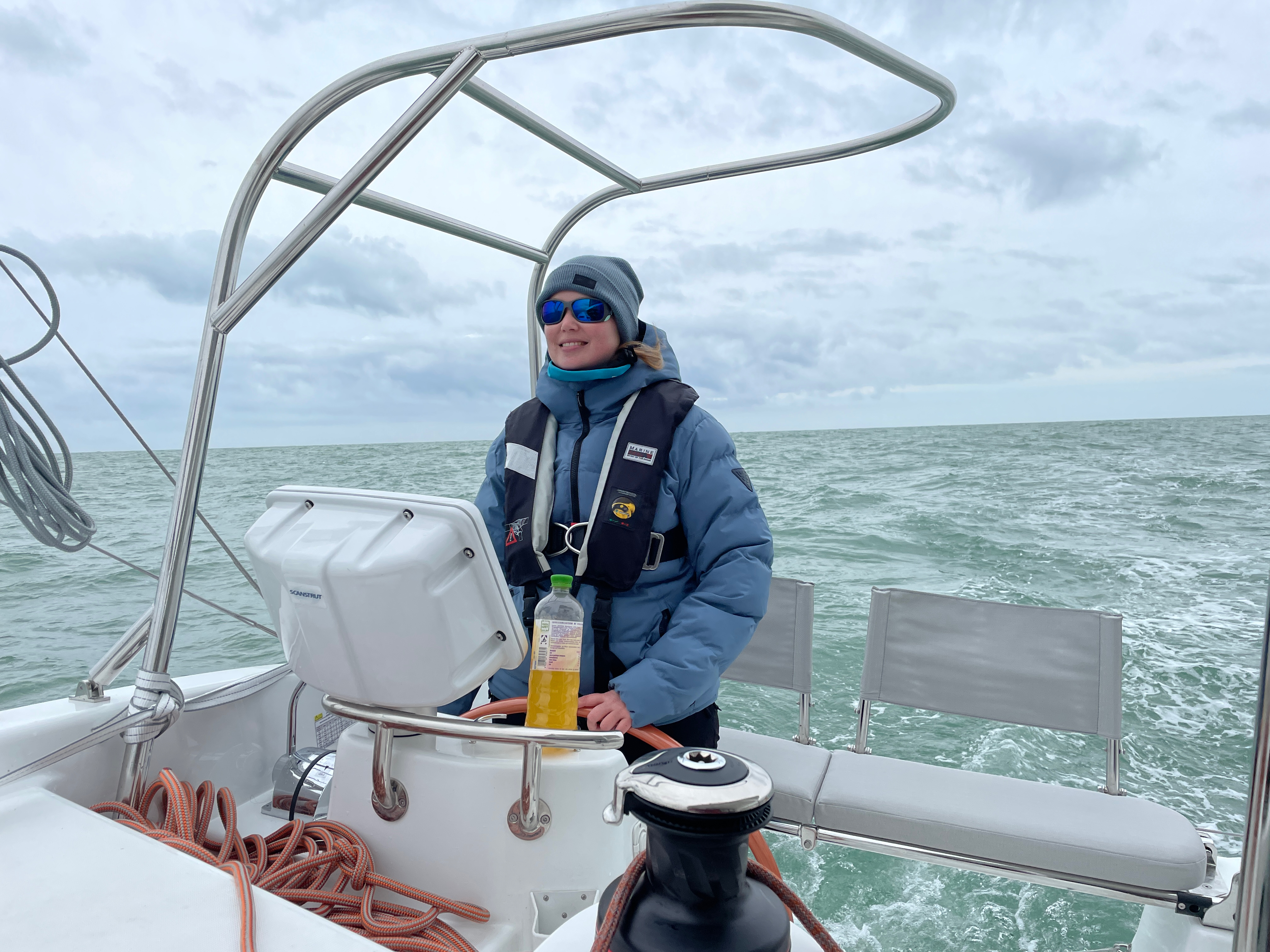
Marina manoeuvres are one of the biggest challenges for many sailors, so it’s worth learning as much as possible about the boat and how it handles before you even leave the berth.
One important factor is prop walk. Does the stern move to port or starboard when you engage reverse? Once you know how the boat behaves, you can factor it into your manoeuvres and make getting in and out of the marina much easier.
The good news is that you can test the prop walk while you’re still in the marina – without even leaving the berth.
First, make sure the boat is securely moored so that a strong burst of reverse cannot suddenly send it backwards into the dock.
Once the boat is secure, the test is simple: have one person stand on the port side and another on the starboard side, both slightly forward of the stern, and watch the water.
Another person takes the helm and gives the engine a strong burst in reverse. On one side of the boat, you’ll see the water begin to churn.
If the churning water appears on the starboard side, the stern will move to port when reverse is engaged and power is applied – and vice versa. Once you know which way the stern will move, you can take it into account from your very first departure.

Once you’ve successfully left the berth for the first time, your holiday can begin. Well, almost. The next step is for every member of the crew to familiarise themselves with the boat – especially, of course, the skipper.
It’s a good idea to find a quiet spot where you can focus entirely on how the boat behaves. Then it’s time to practise a few short but important manoeuvres under engine:
Stopping from forward motion: How much reverse power is needed to bring the boat to a stop from different speeds?
Stopping and continuing in the opposite direction: How quickly does the boat start moving again if you suddenly need to reverse your direction in a narrow marina fairway?
Manoeuvring ahead: How tight is the turning circle? How quickly does the boat respond at different speeds?
Manoeuvring astern: How does the boat behave in reverse? Try practising figure eights or circles around a buoy, for example.
Stopping from reverse and continuing in the opposite direction.
Man-overboard manoeuvre using a buoy.
Turning in a confined space: How much room does the boat need to turn? Which direction does it turn more easily? How long does it take for the boat to start moving after applying a burst of power?
To practise these manoeuvres, it’s a good idea to set yourself a defined corridor or find a spacious, quiet area of the marina.
This gives you enough room to practise without pressure, while still creating enough of a confined space to simulate the conditions you’ll encounter when manoeuvring in a marina.
Spend an hour practising these manoeuvres after taking over the boat and you’ll feel much more relaxed when entering your next marina.
You’ll already know how the boat responds, and with a little forward planning, even marina manoeuvres can be handled calmly and without putting on an unwanted show for everyone on the dock.
The golden rule is always: Slow is pro!
As fast as necessary, as slow as possible. This keeps the boat manoeuvrable at all times – and if something does go wrong, any damage is likely to be minimal. ☺
Article written by
Maren Christoffer
Sailing Instructor

€ 4,040
price of the whole boat

€ 2,240
price of the whole boat

€ 1,658
price of the whole boat

€ 4,760
price of the whole boat

€ 5,355
price of the whole boat

€ 2,975
price of the whole boat

€ 2,480
price of the whole boat

€ 2,635
price of the whole boat

Our regular email newsletters include information about our boats, holiday ideas, destination insights and cultural briefings. You can unsubscribe at any time and we'll treat your data with respect, never passing on your details to third parties. Find full details of our data management in our Privacy policy page
By signing up, I agree to Master Yachting's T&C's and Privacy policy

Looking for inspiration for your next sailing holiday? Packed with insights on trending sailing destinations plus stories from expert sailors and first-timers, our brand new digital magazine - Magister Navis - will guide your way to your next sail.
View magazine

